IDES vs LDES

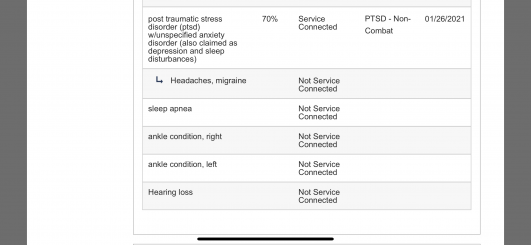
oh really it's the 100% on the VA side that CRSC looks at, hmmm that's interesting. I think I was watching a presentation on Youtube about CRSC. They was talking about how the CRSC raters doesn't really care what VA says are Combat related, CRSC make their own determination on what they believe are combat related. It's strange. Is there a place to see if your VA ratings are rated as combat related or not? because my VA decision letters definitely doesn't say nothing about combat
The video is correct, CRSC doesn't look at what the PEB or VA determines to be combat-related as the law(s) enacting CRSC were written differently and made the requirements more stringent. I couldn't tell you where to look as my 28 conditions were not considered combat-related by the VA either, not that it would matter in the grand scheme of things. Was that video on Sergeant Schultz's (SergeantSchultz1) channel by any chance?
 
oh really it's the 100% on the VA side that CRSC looks at, hmmm that's interesting. I think I was watching a presentation on Youtube about CRSC. They was talking about how the CRSC raters doesn't really care what VA says are Combat related, CRSC make their own determination on what they believe are combat related. It's strange. Is there a place to see if your VA ratings are rated as combat related or not? because my VA decision letters definitely doesn't say nothing about combat
CRSC is directly associated with the VA ratings in several ways:

—CRSC replaces some or all of the retired pay waived for receipt of VA compensation.
—One of the CRSC ceilings is found in the VA compensation tables for the approved CRSC percentage. Note: CRSC cannot exceed the longevity portion of retirement pay.
—Many CRSC recipients are not medically retired; they have reserve or regular retirements. I had a regular retirement in 1991.
All my retired pay is waived and I receive 100% CRSC. My VA awards mention exposure to Agent Orange in Vietnam, but nothing about combat.
—CRSC is not limited to disabilities incurred in a combat zone.

Ron
cc: @RetiredColonel-MikeT
 
oh really it's the 100% on the VA side that CRSC looks at, hmmm that's interesting. I think I was watching a presentation on Youtube about CRSC. They was talking about how the CRSC raters doesn't really care what VA says are Combat related, CRSC make their own determination on what they believe are combat related. It's strange. Is there a place to see if your VA ratings are rated as combat related or not? because my VA decision letters definitely doesn't say nothing about combat
Will show on ebenefits
 

Attachments

  • B57798A8-3571-4F49-A552-ED764227907D.png
    B57798A8-3571-4F49-A552-ED764227907D.png
    263.4 KB · Views: 15
oh really it's the 100% on the VA side that CRSC looks at, hmmm that's interesting. I think I was watching a presentation on Youtube about CRSC. They was talking about how the CRSC raters doesn't really care what VA says are Combat related, CRSC make their own determination on what they believe are combat related. It's strange. Is there a place to see if your VA ratings are rated as combat related or not? because my VA decision letters definitely doesn't say nothing about combat
Also, in looking back at this, you misinterpreted what I was saying: CRSC looks at those conditions the VA rates at 10% or more, i.e., that make up the 100% in that person's case, it does NOT just look at the DoD-rated conditions. You still have to show a causal relationship between the condition and a combat-related event.
 
Also, in looking back at this, you misinterpreted what I was saying: CRSC looks at those conditions the VA rates at 10% or more, i.e., that make up the 100% in that person's case, it does NOT just look at the DoD-rated conditions. You still have to show a causal relationship between the condition and a combat-related event.
Excellent.

And as been mentioned previously, hundreds of CRSC recipients did not have a MEB nor a disability retirement.

Ron
 
The video is correct, CRSC doesn't look at what the PEB or VA determines to be combat-related as the law(s) enacting CRSC were written differently and made the requirements more stringent. I couldn't tell you where to look as my 28 conditions were not considered combat-related by the VA either, not that it would matter in the grand scheme of things. Was that video on Sergeant Schultz's (SergeantSchultz1) channel by any chance?
No, not Sergeant Schultz but a "NVLSP-National Veterans Legal Services Program" video call "know your rights Combat Related Special Compensation" dated 9-16-2020.
 
General Background Information--Concurrent Receipt. This report does not discuss the differences between PEB and VA ratings.

Introduction.

Concurrent receipt refers to the simultaneous receipt of two types of monetary benefits: military retired pay and Department of Veterans Affairs (VA) disability compensation. With several separate programs, varying eligibility criteria, and several eligibility dates, some observers find the subject complex and somewhat confusing. There are, however, two common criteria: first, all recipients are military retirees; second, they are also eligible for VA disability compensation.

This report addresses the two primary components of the concurrent receipt program: Combat-Related Special Compensation (CRSC) and Concurrent Retirement and Disability Payments (CRDP). It reviews the possible legislative expansion of the program to additional populations and provides several potential options for Congress to consider.

Background.

In 1891, Congress first prohibited payment of both military retired pay and a disability pension under the premise that it represented dual or overlapping compensation for the same purpose. The original law was modified in 1941, and the present system of VA disability compensation offsetting military retired pay was adopted in 1944. Under this system, retired military personnel were required to waive a portion of their retired pay equal to the amount of VA disability compensation, a dollar-for-dollar offset.1 If, for example, a military retiree received $1,500 a month in retired pay and was rated by the VA as 70% disabled (and therefore entitled to approximately $1,000 per month in disability compensation), the offset would operate to pay $500 monthly in retired pay and the $1,000 in disability compensation. The advantage for the retiree was that VA disability compensation was not taxable. For many years some military retirees and advocacy groups sought a change in law to permit receipt of all, or some, of both payments. Opponents of concurrent receipt frequently referred to it as double dipping, maintaining that it represented two payments for the same condition.

In the FY2003 NDAA (P.L. 107-314), Congress created a benefit known as Combat Related Special Compensation (CRSC). CRSC provided, for certain disabled retirees whose disability is combat-related, a cash benefit financially identical to what concurrent receipt would provide them. The FY2004 NDAA (P.L. 108-136) authorized, for the first time, the phase-in of actual concurrent receipt (now referred to as Concurrent Retirement and Disability Payments or CRDP), and a greatly expanded CRSC program. The FY2005 NDAA (P.L. 108-375) further liberalized the concurrent receipt rules contained in the FY2004 NDAA and authorized immediate concurrent receipt for those rated by the VA totaling 100%. The FY2008 NDAA (P.L. 110-181) expanded concurrent receipt eligibility to include those who are 100% disabled due to unemployability and provided CRSC to those who were medically retired or retired prematurely due to force reduction programs prior to completing 20 years of service. CRDP phase-in was fully implemented by 2014, allowing retirees with a disability rated at 50% or greater to receive full retired pay and full VA disability compensation without an offset.

[excerpt from Congressional Research Services Report, LINK <--- ]

Ron
 
No, not Sergeant Schultz but a "NVLSP-National Veterans Legal Services Program" video call "know your rights Combat Related Special Compensation" dated 9-16-2020.
Cool, thanks for the title, going to have to see what they say. I saw one video about CRSC that I commented on where the speaker had ZERO clue what they were talking about. NVLSP is legit on the other hand.
 
Top